Beyond the Stereotype: Clinical Oversight and Risk Stratification for the Intoxicated Patient
In the demanding world of pre-hospital care, few presentations are as common, yet as clinically fraught, as the intoxicated patient. For many frontline staff, the "Saturday night" stereotype can lead to a dangerous level of complacency. However, when viewed through the lens of clinical advice and safety, intoxication should never be treated as a simple diagnosis. It is a complex, high-risk, and low-frequency decision-making area that demands the highest level of expert paramedic oversight.
At Lynas, we understand that managing these patients in the field or in remote environments requires more than just patience; it requires a robust framework for risk stratification. This article explores why intoxication is the ultimate "clinical red herring" and how remote clinical support can help teams navigate the physiological and legal complexities involved.
The Danger of Diagnostic Overshadowing
One of the most significant risks clinicians face is "diagnostic overshadowing." This is a cognitive bias where a practitioner sees a patient who smells of alcohol, is slurring their words, and perhaps being difficult, and assumes every symptom is caused by ethanol. In reality, alcohol is a mask.
As an experienced first responder, your job is not to prove that a patient is drunk. Your job is to prove they are not dying of something else. Alcohol inhibits the central nervous system, meaning it can mask the early signs of rising intracranial pressure. A patient who has fallen while intoxicated might not show the typical Cushing’s triad or focal neurological deficits until they are coning. We must always consider that a reduced Glasgow Coma Scale (GCS) in a patient who has been drinking could just as easily be:
A subdural haematoma or other traumatic brain injury.
An ischaemic or haemorrhagic stroke.
Post-ictal confusion following an unwitnessed seizure.
If a clinician labels a patient as "just a drunk," they have effectively stopped their diagnostic process. This is exactly where serious clinical errors occur and where coroners' cases often begin.
Airway Management: The Highest Immediate Risk
From a physiological perspective, airway management is the highest immediate risk for the intoxicated patient. Ethanol is both a potent gastric irritant and a CNS depressant. In the back of an ambulance, this combination can be dangerous.
These patients often lose their protective airway reflexes. Their gag and cough reflexes are significantly diminished, making them unable to clear their own airway when they vomit. Silent aspiration is a major killer in this cohort. When gastric acid is inhaled into the lungs, it leads to chemical pneumonitis and, eventually, Acute Respiratory Distress Syndrome (ARDS).
Furthermore, positioning an intoxicated patient for airway protection is a physical challenge. Maintaining a lateral decubitus position on a narrow stretcher with a patient who may be flaccid or intermittently combative requires constant vigilance. These patients require continuous, one-to-one visual monitoring. They cannot simply be "put in the back" while the crew focuses elsewhere.
Metabolic and Environmental Traps
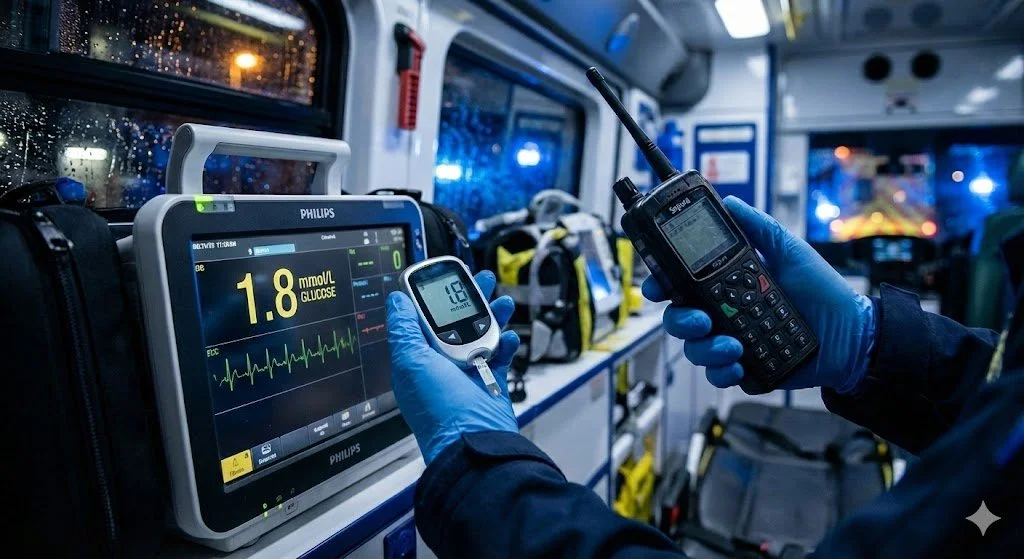
The "hypo trap" is a common failure in the basic standard of care. Ethanol inhibits gluconeogenesis in the liver. Whether it is a chronic heavy drinker or an adolescent on a binge, these patients can easily become profoundly hypoglycaemic. Every single intoxicated patient must have their blood glucose level checked. A patient written off as "comatose from drink" may actually be in a life-threatening hypoglycaemic coma.
We must also consider environmental risks. Alcohol causes peripheral vasodilation, which gives the patient a false sense of warmth while their core temperature is actually plummeting. In the UK, hypothermia is a year-round risk for intoxicated patients collapsed on cold surfaces. Hypothermia interferes with blood clotting, which, when combined with alcohol’s inherent anti-platelet effect, makes any traumatic injury significantly more dangerous.
The Modern "Cocktail" Risk
In the current pre-hospital care landscape, we are rarely dealing with pure ethanol. Most patients involve poly-pharmacy, whether it is prescribed gabapentinoids, diverted benzodiazepines, or synthetic cannabinoids. These substances synergise with alcohol to create unpredictable respiratory depression.
A patient might appear stable initially, but as the different peaks of these substances hit their system, they can rapidly progress to respiratory arrest. This is why top cover and constant monitoring are essential for "the quiet ones." While a shouting patient is moving air, the quiet, sleeping patient is the one at risk of stopping breathing.
Legal and Ethical Frameworks: The Mental Capacity Act
Determining capacity in an intoxicated patient is one of the most difficult tasks a paramedic performs. Under the Mental Capacity Act (MCA) 2005, capacity is time-specific and decision-specific. However, alcohol creates a "fluctuating capacity" that is notoriously hard to document.
The risk is twofold: leaving a patient at home who lacks capacity, resulting in harm, or taking a patient to the hospital against their will, leading to allegations of assault. The "Best Interests" framework is our primary tool here. If a patient is so intoxicated that they cannot understand, retain, or weigh up information regarding their health, we have a duty of care to act.
Your documentation must be bulletproof. It is essential to record:
Exactly why you believe they lacked capacity.
What specific risks were explained to them.
Why the actions taken were the least restrictive option to save their life.
Conclusion: Intoxication as a Complication, Not a Diagnosis
To maintain clinical safety, we must treat intoxication as a complication rather than a diagnosis. Clinicians must maintain a high index of suspicion for trauma, metabolic derangement, and poly-pharmacy. Never let a patient’s behaviour erode your clinical standards.
By approaching every intoxicated patient as a high-risk medical emergency until proven otherwise, you ensure the safest possible outcome for the patient and the most robust protection for you and your organisation. Providing teams with reach back to expert paramedic advice ensures that these complex decisions are made with the support and oversight they deserve.
If your team operates in challenging or high-risk environments, don't wait for a compliance gap or medical emergency to find you. Take the next step in securing definitive remote clinical support and expertise. Book a consultation with the expert team at Lynas today to discuss your specific operational requirements and learn how we can fill your essential pre-hospital care needs.
The Lynas Advantage: Your Clinical Safety Net
Lynas’s Safety & Support Centre is regulated by the Care Quality Commission (CQC) and offers:
24/7 Access to Advanced Paramedic Practitioners: A direct line to experts with years of NHS, events, and other experience.
Real-Time Clinical Decision Support: Immediate guidance 24/7 on complex cases like paediatric emergencies, mental health crises, and safeguarding.
Surge Capacity & Crisis Backup: Seamlessly supporting overwhelmed teams during peaks in demand, staff absences, or major incidents.
Robust Clinical Governance: Including robust audits and secure, searchable records of all advice provided.
We bridge the gap between frontline challenges and clinical best practice, empowering your organisation to mitigate risk with real-time expert guidance and enhance compliance.
If your team operates in challenging or high-risk environments, don't wait for a compliance gap or medical emergency to find you. Take the next step in securing definitive remote clinical support and expertise. Book a consultation with the expert paramedic team at Lynas today to discuss your specific operational requirements and learn how we can fill your essential pre-hospital care needs.